1. The MOQ Challenge for Made-to-Order Fashion
For independent designers, emerging ateliers, and made-to-order (MTO) fashion labels, traditional textile supply chains present a significant structural barrier. Conventional mills typically enforce strict Minimum Order Quantities (MOQs)—often demanding commitments of 300 to 1,000 yards per dye lot or colorway.
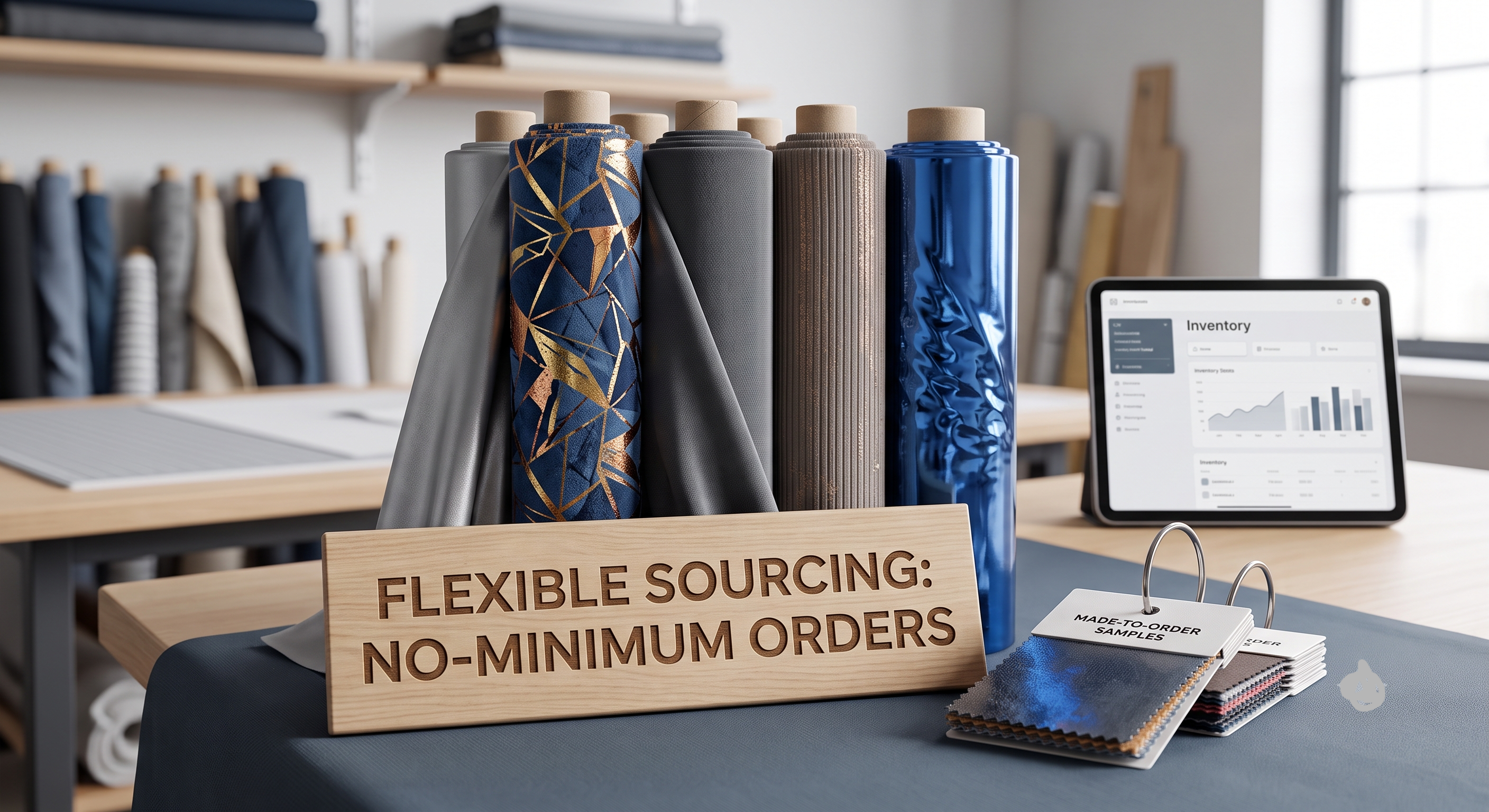
For brands operating on an on-demand, zero-inventory production model, locking capital into large fabric rolls contradicts their core value proposition: eliminating waste, reducing overhead, and responding dynamically to client orders. Navigating the market requires actionable sourcing guides on no-minimum order flexibility for made-to-order brands, allowing designers to scale sustainably without over-leveraging their cash flow.
2. Strategic Pathways to Low- and No-Minimum Sourcing
Securing high-quality textiles without massive yardage commitments requires shifting away from single-mill direct contracts toward agile sourcing channels.
A. Wholesale Suppliers with Stocked Open Lines
-
How It Works: Sourcing from jobbers and wholesale distributors that maintain deep in-stock inventories of core fabrics.
-
The MTO Advantage: These suppliers absorb the initial mill MOQs and allow designers to purchase cut yardage as small as 1 yard for sampling or single-roll increments for small-batch runs.
-
Continuity Assessment: Ensure the fabric is part of a re-orderable open line rather than a one-off closeout so you can reliably produce repeatable garments season after season.
B. Designer Deadstock & Surplus Sourcing
-
How It Works: Purchasing excess yardage leftover from major fashion houses or over-production runs.
-
The MTO Advantage: Deadstock offers zero or very low minimums, often featuring luxury-tier fibers and specialty finishes at discounted rates.
-
The Trade-Off: Deadstock is finite; once a roll is exhausted, it cannot be duplicated. Best suited for limited-edition capsule drops or one-of-a-kind bespoke commissions.
C. Digital Fabric Marketplaces
-
How It Works: Online sourcing networks connect emerging labels directly to global suppliers offering low-MOQ or automated sample-cutting services.
-
The MTO Advantage: Many platforms allow designers to build custom swatch boxes and order small quantities without importer friction.
3. Comparing Sourcing Models for Emerging Labels
| Sourcing Model | Typical MOQ | Re-Orderability | Lead Time | Best Application for MTO Brands |
| Traditional Textile Mill | 300–1,000+ Yards | High (Custom Dye Lots) | 6–12 Weeks | High-volume production once a silhouette is proven at scale |
| In-Stock Wholesale Supplier | 1 Yard – 1 Roll | High (Open Stock Lines) | 2–5 Days | Continuous made-to-order core collections and quick sampling |
| Deadstock / Surplus | No Minimum | Low (Finite Supply) | Immediate | Limited capsule runs, upcycled drops, and bespoke garments |
| Digital Low-MOQ Platforms | 1–5 Yards | Moderate to High | 1–3 Weeks | Testing new materials and sampling avant-garde silhouettes |
4. Essential Questions to Ask Your Fabric Supplier
When evaluating a potential supplier for no-minimum flexibility, ask explicit technical questions to protect your production timeline: 
-
"Is this item re-orderable stock, and what is your average continuity timeframe?"
Confirm whether the fabric is maintained year-round or scheduled for seasonal discontinuation.
-
"What is the exact fabric width and usable cuttable area?"
Most apparel fabrics are 58"–60" wide, but specialty silks or knits may measure 44"–45", directly impacting your pattern yield and marker efficiency.
-
"What are your tiered pricing thresholds?"
Many suppliers offer no-minimum sample yardage while discounting bulk prices starting at 15-, 30-, or 50-yard roll increments.
-
"What is the lead time for cut yardage versus full rolls?"
Clarify whether sample cuts ship from an on-site showroom or require dispatch from a remote warehouse.