
When sourcing stretch fabrics for activewear, swimwear, dancewear, or cosplay, two technical terms appear on nearly every specification sheet: stretch and recovery. While they are often used interchangeably by beginners, they describe two completely different mechanical properties of a textile.
Understanding the distinction between how a fabric extends and how it returns is critical to creating fitted garments that look professional, feel comfortable, and stand the test of time.
1. What is Fabric Stretch? (The Extension)
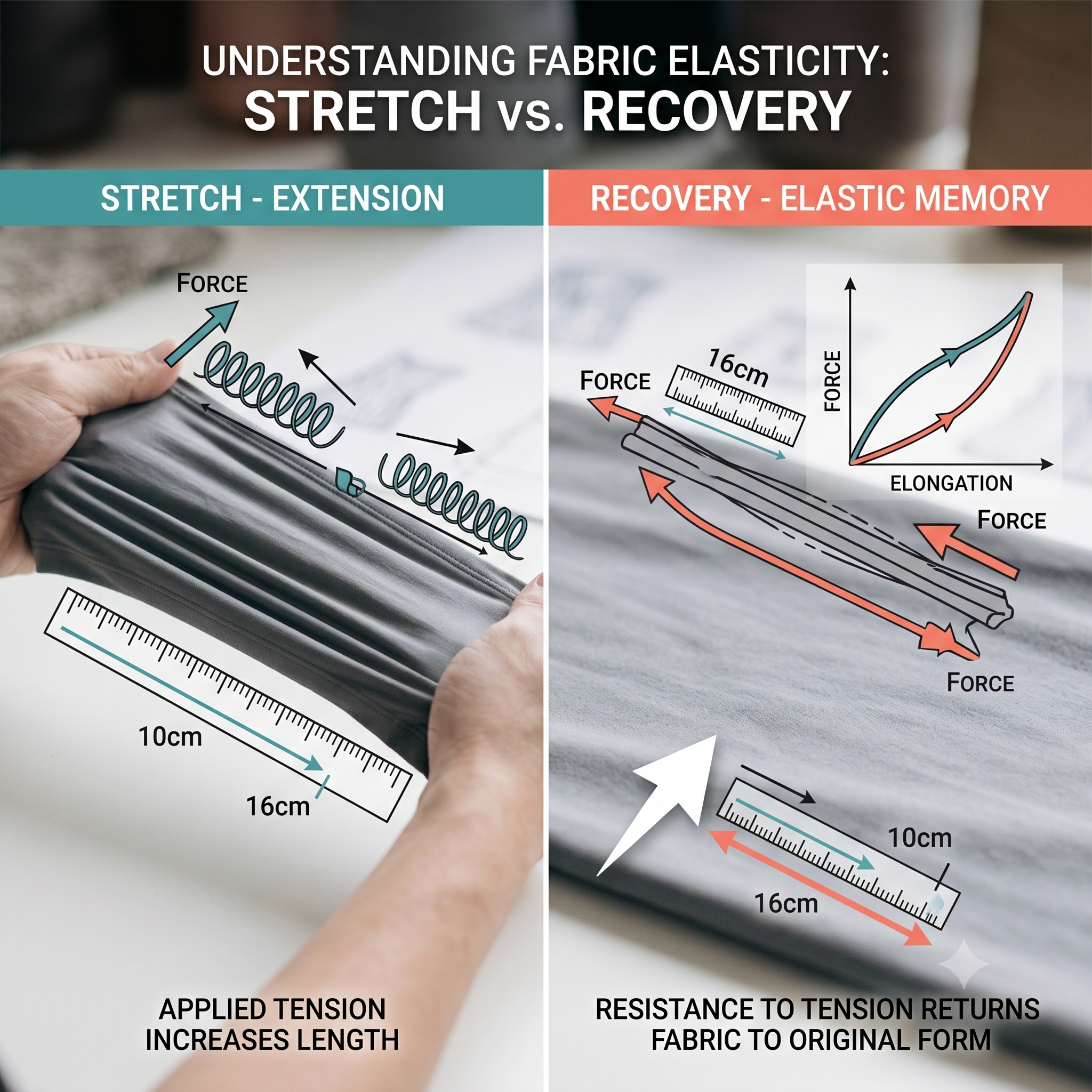
Stretch refers to the maximum capacity of a fabric to elongate under tension without breaking or tearing. It is a measure of flexibility and range of motion.
When you pull a knit or spandex-blend textile across its grain, the percentage of elongation tells you how much extra room the fabric can provide:
-
2-Way Stretch: Elongates primarily in one direction (usually from selvedge to selvedge across the crossgrain).
-
4-Way Stretch: Elongates both horizontally across the crossgrain and vertically along the lengthwise grain.
Why Stretch Matters:
-
Ease of Movement: High stretch allows garments to move seamlessly with the human body during athletic or stage performance.
-
Fit & Compression: It enables designers to create form-fitting silhouettes that conform to complex curves without restricting circulation or breathing.
2. What is Fabric Recovery? (The Snap-Back)
Recovery is the ability of a fabric to return immediately and completely to its original dimensions after being stretched. If stretch is about flexibility, recovery is about resilience and memory.
A fabric's recovery power is largely determined by the quality and percentage of elastomeric yarns (such as Spandex, Lycra, or Elastane) knitted into the base fiber structure, as well as the tightness of the knit gauge.
Why Recovery Matters:
-
Shape Retention: High recovery prevents garments from stretching out, bagging at the knees or elbows, or sagging after a few hours of wear.
-
Durability: Fabrics with poor recovery experience fiber fatigue quickly, resulting in rippled seams, distorted waistbands, and permanent garment deformation.
-
Consistent Compression: For performance activewear and swimwear, reliable snap-back ensures the garment continues to support the wearer wash after wash.
3. Key Differences at a Glance
| Property | Stretch | Recovery |
| Definition | How far a fabric can pull or elongate under tension. | How quickly and completely fabric returns to its original size. |
| Primary Benefit | Comfort, range of motion, and contouring fit. | Long-term shape retention, durability, and compression. |
| Common Failure | Fabric feels too rigid or restricts physical movement. | Garment bags out, sags, or loses its silhouette over time. |
| Key Indicator | Measured as a stretch percentage (e.g., 50% or 100% stretch). | Measured by the lack of residual "growth" after release. |
4. How to Perform a Quick Studio Test
You can evaluate both properties in seconds using a ruler and a 4-inch fabric swatch:
-
Test Stretch: Place a 4-inch swatch against a ruler. Hold one end at
0and pull the other end comfortably without straining the fibers. If it extends to6 inches, the fabric has 50% stretch. -
Test Recovery: Hold the fabric at that stretched position for 5 to 10 seconds, then let go.
-
Excellent Recovery: The swatch snaps back immediately to exactly 4 inches with flat, smooth edges.
-
Poor Recovery: The swatch remains elongated (e.g., measuring 4.25 inches) or looks wavy and puckered along the edge.
-